- Front Page
- Politica
- Local
- Internacional
- Deporte
- Analisis
- Investiga
- Live
- LenguahePapiamento

Chamber of Commerce warns of risks in linking minimum wage to subsistence minimum
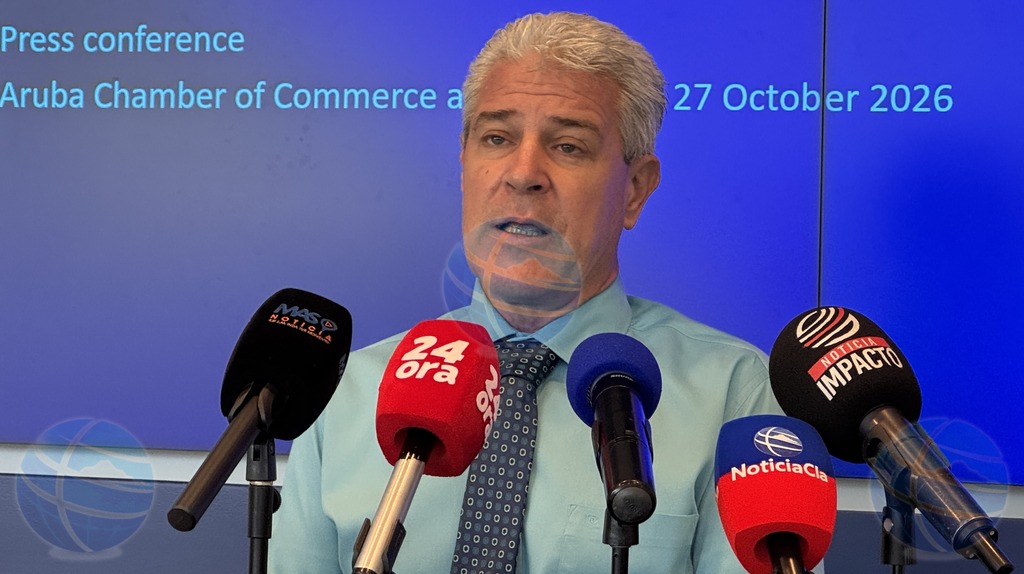
ORANJESTAD — The Aruba Chamber of Commerce (KvK) shares concerns about the high cost of living and the need to improve workers' purchasing power. However, the organization questions the government's intention to gradually raise the minimum wage to the subsistence minimum (bestaansminimum). According to its director, Martijn Balkenstein, such a measure could have serious economic consequences, particularly for small businesses and employment, if the necessary research is not conducted first. During a press conference on Tuesday morning, Balkenstein explained that the Chamber of Commerce is not opposed to increasing the minimum wage. Its main concern is that the government is considering a major change in wage policy while essential information is still missing to determine who actually needs assistance and what the economic impact will be.
OUTDATED FIGURES AS THE BASIS FOR A MAJOR DECISION
Balkenstein indicated that the current minimum wage is approximately Afl. 2,070, while the subsistence minimum for a single person is around Afl. 2,670. This represents a difference of approximately Afl. 600. According to the director, the minimum wage has increased by 37.5 percent since 2000, while overall inflation has risen by approximately 33 percent. This indicates that the minimum wage has kept pace with, and even slightly exceeded, general inflation. The problem, according to Balkenstein, is that the subsistence minimum has increased much faster, mainly because of rising food and housing costs. However, there is another fundamental problem. The subsistence minimum is based on a 2006 income and expenditure survey conducted by the Central Bureau of Statistics (CBS), which was used for calculations in 2010. "We are talking about an information base that is 20 years old. The economic situation and household spending patterns have changed since then," Balkenstein expressed as his concern. For the Chamber of Commerce, this means that before the government links the minimum wage to the subsistence minimum, it must determine whether these figures still accurately reflect Aruba's current reality.
NOBODY KNOWS EXACTLY HOW MANY FAMILIES LIVE BELOW THE SUBSISTENCE MINIMUM
During his presentation, Balkenstein indicated that approximately 5,000 workers earn between the minimum wage and the subsistence minimum. In addition, around 5,300 people earn less than Afl. 2,000, mainly because they work part-time. According to the figures presented, a considerable number of workers could be affected directly or indirectly. However, Balkenstein emphasized that an individual's salary is not the same as a household's total income. Someone may earn the minimum wage but live in a household where other members earn enough to cover expenses. At the same time, there may be families with several dependents and only one source of income that are experiencing genuine financial hardship. "Currently, nobody in Aruba knows exactly how many families live below the subsistence minimum," Balkenstein pointed out. For the Chamber of Commerce, this is one of the most important questions the government must answer before implementing a wage policy change of this magnitude.
WAGE INCREASES COULD LEAD TO JOB LOSSES
One of the Chamber of Commerce's strongest warnings concerns the possible effects on businesses and the labor market. Balkenstein referred to international experiences and studies which, according to him, indicate that excessively large wage increases can create difficulties for businesses operating with limited profit margins. Aruba has many small businesses employing only two or three people. For such businesses, a substantial increase in labor costs may be difficult to absorb. According to Balkenstein, the consequences could include businesses stopping recruitment, reducing working hours, eliminating certain additional benefits or, in more extreme cases, laying off employees. The director also mentioned the possibility that some businesses might no longer be able to compete and could eventually close. The paradox, according to his explanation, is that a measure intended to improve workers' incomes could ultimately harm some of those same workers if they lose their jobs.
RISK OF FURTHER PRICE INCREASES
The Chamber of Commerce also warns of another possible consequence: inflation. When a company's labor costs increase significantly, it may decide to pass some of those additional expenses on to consumers by raising the prices of its products or services. This could mean that a wage increase loses part of its positive effect because the cost of living continues to rise. Balkenstein noted that this could also affect the tourism sector, where higher operating costs might eventually translate into higher prices for visitors. According to the director, Aruba must avoid a situation in which a measure intended to improve purchasing power ends up making the island even more expensive.
CHAMBER OF COMMERCE PROPOSES A DIFFERENT APPROACH
Instead of automatically linking the minimum wage to the subsistence minimum, the Chamber of Commerce proposes a broader approach to improving purchasing power. Balkenstein stated that the minimum wage should continue to be adjusted for inflation, but that the main problem requiring attention is Aruba's excessively high cost of living. Among the possible measures mentioned by the Chamber of Commerce are tax relief for low-income earners, assistance for families struggling with debt, and greater investment in education and vocational training. According to Balkenstein, training is essential to increasing worker productivity, thereby creating opportunities for wages to continue rising without putting the sustainability of businesses at risk. The director emphasized that improving purchasing power should not depend exclusively on wage increases, but rather on a combination of economic and social measures.
CHAMBER OF COMMERCE REGRETS NOT BEING INVOLVED FROM THE BEGINNING
During the press conference, Balkenstein expressed disappointment that the Chamber of Commerce had not been involved from the beginning in preparing the proposal. According to him, a change that could profoundly affect the labor market and the economy should be developed through dialogue with the government, employers and other relevant organizations. Although the Chamber of Commerce has been invited to participate in parliamentary discussions, Balkenstein believes that cooperation should have started much earlier. His main message is that the Chamber of Commerce does not reject the need to help workers, but is urging the government to avoid making decisions based on incomplete information and without properly calculating the possible consequences. For Balkenstein, the challenge is not simply to determine how much the minimum wage should increase, but how Aruba can improve its residents' purchasing power without putting jobs, businesses and the national economy at risk.