- Front Page
- Politica
- Local
- Internacional
- Deporte
- Analisis
- Investiga
- Live
- LenguahePapiamento

- RAPP ta pone etica y uzo practico di AI den periodismo central na seminario
- Heyliger (AVP): Norma salarial mester permiti Aruba retene profesionalnan
- Gerlien Croes: Ley pa limita salario halto no mester laga Aruba sin profesional
- E pakico flexibilisacion di LNT por afecta control salarial y relacion cu Hulanda
- Sospechoso di 15 aña deteni despues cu dos hoben a wordo hinca
- RAPP ta pone etica y uzo practico di AI den periodismo central na seminario
- Heyliger (AVP): Norma salarial mester permiti Aruba retene profesionalnan
- Gerlien Croes: Ley pa limita salario halto no mester laga Aruba sin profesional
- E pakico flexibilisacion di LNT por afecta control salarial y relacion cu Hulanda
- Sospechoso di 15 aña deteni despues cu dos hoben a wordo hinca
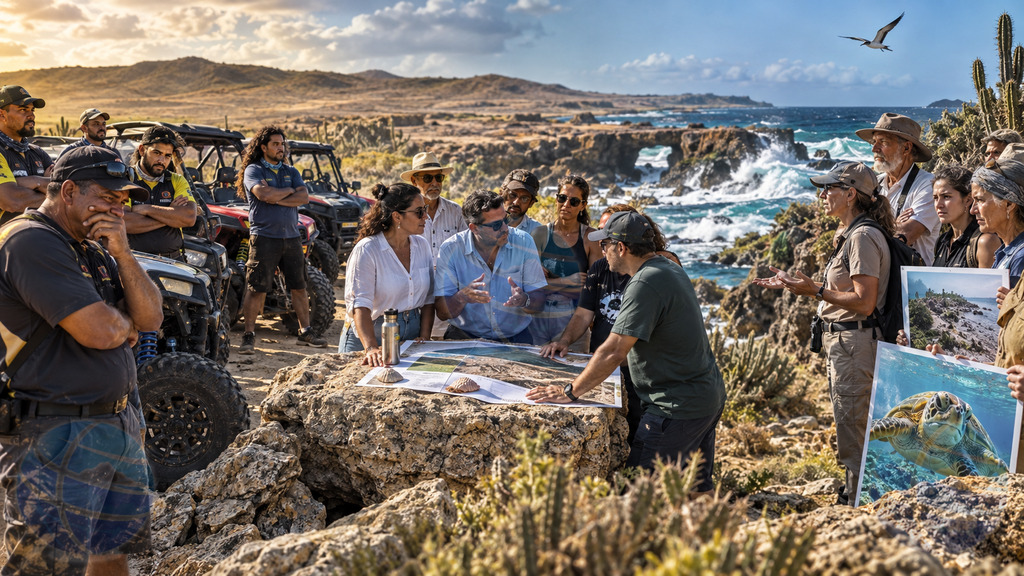
Survey reveals common ground: protect nature and jobs with UTVs under strict control
ORANJESTAD — Aruba may appear deeply divided over UTVs and ATVs. On one side are workers and business owners who fear losing their income if the government restricts or eliminates the activity. On the other are residents and organizations that see the vehicles as a threat to nature and want much stricter restrictions.
But the latest Noticiacla survey indicates that between those two extremes there is a much larger group looking for a middle-ground solution.
Perhaps the most revealing result is this: if a legally controlled route can protect nature while keeping tour operators at work, 50.7% say “yes” directly and 40.1% say “it depends on the conditions.”
That means 90.7% are not closing the door on a compromise solution.
Only 9.2% say they would not support such a model.
That figure puts the current division in a different perspective.
IT IS NOT A CHOICE BETWEEN NATURE OR JOBS
91% of respondents consider protecting nature important or extremely important.
At the same time, 60% consider protecting jobs and tour operator businesses important or extremely important.
The two figures may appear contradictory, but they show exactly where the possibility for agreement lies.
Most respondents want nature protected. But a large group also does not want to see the government simply eliminate jobs if a controlled alternative can be found.
This is confirmed by the question about the preferred solution.
38.1% want an officially designated route. Another 24.5% want an alternative route outside the most sensitive areas. Combined, that is 62.6%.
26% want a complete ban on UTVs and ATVs in natural areas.
Only 6.2% want things to continue as before.
The real loser in the survey, therefore, is the status quo.
ALLOW THEM, BUT WITH TEETH
The kind of regulation respondents support is not a soft system.
Nearly 70% want heavy fines for violations.
69.2% want an absolute ban on leaving designated routes.
64.2% want a maximum speed.
61.8% want a limit on the number of vehicles.
53.9% support mandatory licensed guides, while 51.6% want GPS or other electronic controls.
This indicates that for many participants, “allowing” the activity is acceptable only if the government can guarantee that the rules are actually enforced.
THE EXTREMES ARE NOT THE MAJORITY
31.2% said directly that UTVs and ATVs should no longer operate on the north coast.
That is a significant group and cannot be ignored.
But 47.4% want the activity to continue under strict conditions and another 21.4% support allowing it to continue.
On the other side, the group that literally wants everything to continue as before is only 6.2%.
So neither the “no change” camp nor the most absolute position dominates the results.
The center of gravity is regulation.
AGE AND PROFILE: WHAT WE CAN SAY — AND WHAT WE CANNOT
The survey had a relatively mature group of respondents. More than 70% are aged 45 or older, while fewer than 11% are between 18 and 34.
Almost 80% were born and raised in Aruba, while another 13.7% have lived on the island for more than 20 years.
88% do not own or regularly use a UTV or ATV, and 72% do not have a close family member working in the sector.
This gives a good indication of who participated in the survey.
However, the data currently available to Noticiacla does not allow each individual response to be cross-referenced with age, district, gender or occupation. It would therefore not be correct to claim, for example, that retirees are more opposed to UTVs or that tourism workers are more supportive.
To draw those kinds of conclusions, the individual raw survey data would be required.
A POSSIBLE CONSENSUS
What the figures do allow us to conclude is that the space for compromise is considerably larger than the public debate may suggest.
Most respondents rank nature protection highly.
A majority also recognizes the importance of employment.
Nearly two out of three choose an official or alternative route as the main solution.
And more than nine out of ten are at least open to a legally controlled route if it protects nature and keeps people employed.
The result puts the following question on the table for the government: if so many people are open to a balanced solution, why does Aruba still not have the regulation, routes and enforcement needed to implement one?
Especially considering that 81.9% of respondents believe the government has not done enough so far, the pressure to finally move from discussion to action is clear.
DISCLAIMER
An important editorial point: Noticiacla does not present this survey as “the opinion of Aruba as a whole” without qualification, because it is an open Noticiacla survey and not a weighted probabilistic sample. The safer formulation is “among respondents to the Noticiacla survey.”