- Front Page
- Politica
- Local
- Internacional
- Deporte
- Analisis
- Investiga
- Live
- LenguahePapiamento

- RAPP ta pone etica y uzo practico di AI den periodismo central na seminario
- Heyliger (AVP): Norma salarial mester permiti Aruba retene profesionalnan
- Gerlien Croes: Ley pa limita salario halto no mester laga Aruba sin profesional
- E pakico flexibilisacion di LNT por afecta control salarial y relacion cu Hulanda
- Sospechoso di 15 aña deteni despues cu dos hoben a wordo hinca
- RAPP ta pone etica y uzo practico di AI den periodismo central na seminario
- Heyliger (AVP): Norma salarial mester permiti Aruba retene profesionalnan
- Gerlien Croes: Ley pa limita salario halto no mester laga Aruba sin profesional
- E pakico flexibilisacion di LNT por afecta control salarial y relacion cu Hulanda
- Sospechoso di 15 aña deteni despues cu dos hoben a wordo hinca
Survey is not just about UTV users: 88% of respondents do not own or regularly use one
ORANJESTAD — The debate over the future of UTVs and ATVs on Aruba’s north coast is often presented as a confrontation between tour operators and environmentalists. But the Noticiacla survey reveals an important third voice: residents who are not part of the UTV/ATV world, but who do use the coast and have a firm opinion about its future.
NOT UTV/ATV USERS, BUT THEY DO USE THE COAST
Of the 837 people who answered the question, 738 — 88.2% — said they do not own or regularly use a UTV or ATV.
Only 5.6% said they own or regularly use one, while 4.2% use them only during a tour.
The survey therefore does not consist mainly of UTV owners or regular users.
At the same time, 71.9% said that neither they nor a close family member works in the UTV/ATV or tour operator sector.
This is important because it shows that the debate affects a much broader group than only those whose income depends on the industry.
THE NORTH COAST HAS MANY DIFFERENT USERS
87% of respondents visit Aruba’s north coast at least a few times a year. Of them, 19.2% go every week and 21.5% visit a few times a month.
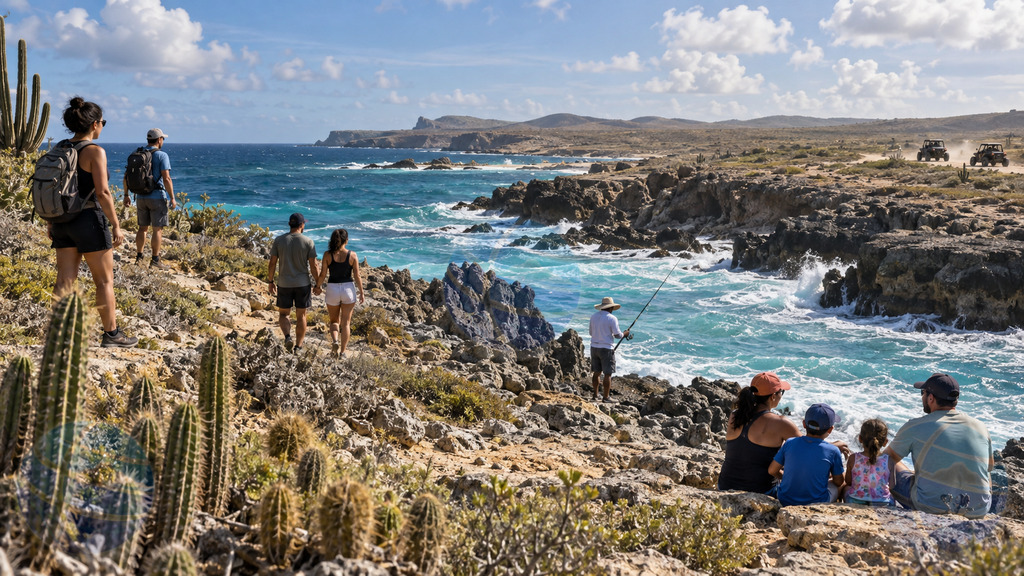
UTV use is not the main reason for those visits. 40.7% go for recreation or sightseeing, 21.2% for hiking or walking, and 16.4% specifically to visit natural areas. Others go for sports, fishing and other activities. Only 2.6% identified tours as their main reason for visiting the north coast.
This adds another dimension to the current conflict. The north coast is not only a route for UTVs and ATVs, nor is it solely a conservation area. It is a shared space used simultaneously by different groups of residents.
That is why 60.4% believe that closing access could unfairly affect traditional fishermen and other users, while another 23.2% believe this could partly be the case. In addition, 68% believe the government should create separate access for fishermen and other traditional coastal users.
A SURVEY DOMINATED BY PEOPLE WITHOUT UTVs
The general profile of respondents is also noteworthy. Approximately 80% were born and raised in Aruba. Another 13.7% have lived on the island for more than 20 years.
More than 70% of participants are aged 45 or older: 24.4% are between 45 and 54, 26.3% between 55 and 64, and 20.2% are 65 or older.
54.9% are men and 41.3% women. 33.5% live in Noord, 18.7% in Santa Cruz, 18.4% in Oranjestad, 14.8% in Paradera, 8.6% in Savaneta and 6% in San Nicolas.
In terms of employment, 55.1% work full-time, 17% are self-employed or business owners, and 20.4% are retired.
53.6% said they do not work directly or indirectly in tourism. 23.9% work directly in tourism and 17.6% indirectly.
That means the survey includes a considerable number of people connected to tourism, but the largest group is not employed in the sector.
THEIR OPINION MATTERS
Because the results file presents aggregated figures per question rather than individual responses, it is not possible to determine exactly how the 738 people who do not use UTVs voted on every question.
But one thing is clear: with 88% of the sample not being regular UTV/ATV users, the overall results cannot simply be dismissed as the opinion of the industry.
At the same time, the results cannot simply be attributed to environmentalists either.
The sample consists mainly of long-term residents, middle-aged and older participants, recreational coastal users and people who do not own a UTV.
Their general message appears to be a call for the north coast to be managed as a shared space: protect nature, regulate vehicles, maintain access for other users and end a situation in which different activities compete without sufficient rules or enforcement.
DISCLAIMER
An important editorial point: Noticiacla does not present this survey as “the opinion of Aruba as a whole” without qualification, because it is an open Noticiacla survey and not a weighted probabilistic sample. The safer formulation is “among respondents to the Noticiacla survey.”