- Front Page
- Politica
- Local
- Internacional
- Deporte
- Analisis
- Investiga
- Live
- LenguahePapiamento

- RAPP ta pone etica y uzo practico di AI den periodismo central na seminario
- Heyliger (AVP): Norma salarial mester permiti Aruba retene profesionalnan
- Gerlien Croes: Ley pa limita salario halto no mester laga Aruba sin profesional
- E pakico flexibilisacion di LNT por afecta control salarial y relacion cu Hulanda
- Sospechoso di 15 aña deteni despues cu dos hoben a wordo hinca
- RAPP ta pone etica y uzo practico di AI den periodismo central na seminario
- Heyliger (AVP): Norma salarial mester permiti Aruba retene profesionalnan
- Gerlien Croes: Ley pa limita salario halto no mester laga Aruba sin profesional
- E pakico flexibilisacion di LNT por afecta control salarial y relacion cu Hulanda
- Sospechoso di 15 aña deteni despues cu dos hoben a wordo hinca
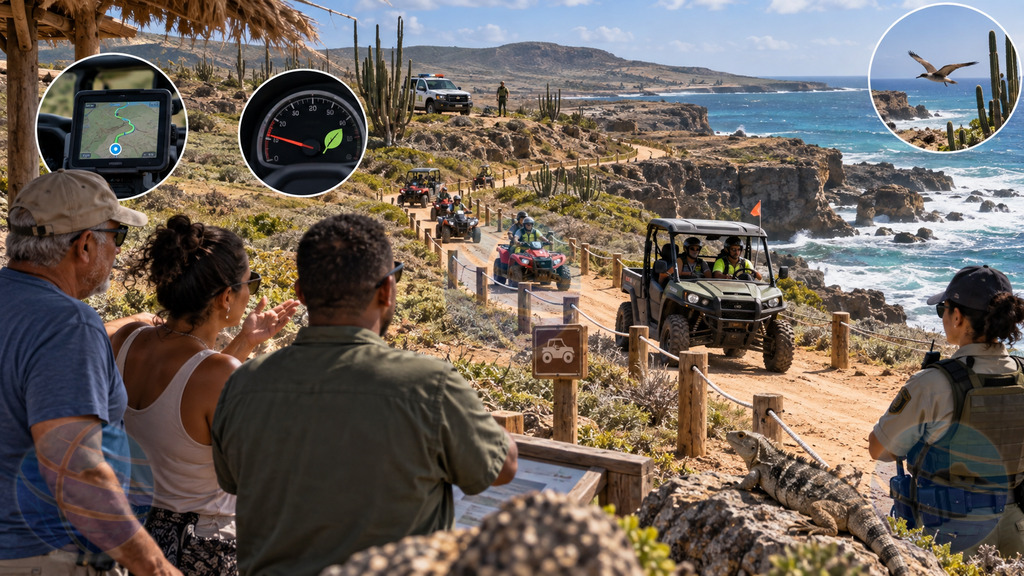
Survey: Majority wants UTV/ATV use under strict controls, not as before
ORANJESTAD — The debate surrounding UTVs and ATVs on Aruba’s north coast is dividing the island, but the latest Noticiacla survey shows a fairly clear direction among respondents: most do not want the activity to continue as before, but a majority also does not favor a total ban. The main preference is strong regulation, controlled routes and protection of nature. Among approximately 840 participants, 47.4% said UTVs and ATVs should only continue operating under strict conditions. Another 21.4% support allowing them to continue, while 31.2% are opposed. When Noticiacla asked which solution respondents considered best, 38.1% chose an officially designated route and 24.5% preferred an alternative route outside the most sensitive areas. That means nearly 63% favor some form of controlled or alternative route. Another 26% want UTVs and ATVs completely banned from natural areas. Only 6.2% chose to let the activity continue as before. That figure is perhaps one of the clearest messages of the survey: the status quo has very little support.
NATURE WEIGHS HEAVILY, BUT SO DO JOBS
Protection of nature is a major priority in the survey. 63.4% rated it as extremely important and 27.6% as important. Combined, that is more than 91%. At the same time, respondents do not ignore the economic consequences for the sector. 27.9% consider protection of jobs and tour operator businesses extremely important, while 32.1% consider it important. Together, 60% place serious weight on preserving employment. The combination shows a view that cannot easily be reduced to simply “pro” or “against”: nature must be protected, but most respondents also do not want jobs to disappear without an alternative being explored. This is strongly confirmed by another question. If a legally controlled route can protect nature while keeping tour operators at work, 50.7% support the idea directly and another 40.1% say their support would depend on the conditions. Only 9.2% reject the idea. In other words, more than 90% are at least open to considering a controlled solution if it genuinely protects both interests.
THE RULES MUST BE STRICT
If UTVs and ATVs are allowed on an official route, respondents want serious controls. 69.5% support heavy fines for violations, 69.2% want a ban on leaving the designated route, 64.2% support a maximum speed and 61.8% want limits on the number of vehicles. More than half also support mandatory licensed guides and GPS or electronic monitoring. In other words, allowing the activity does not mean allowing it without restrictions.
GOVERNMENT RECEIVES THE STRONGEST CRITICISM
One particularly strong result concerns the role of government. Only 5% believe the government has done enough in recent years to regulate UTVs and ATVs. 81.9% say it has not done enough. Confidence that the government can now reach a balanced solution is also low. 37.8% have little confidence and 23.8% have no confidence at all. Combined, more than 61% have little or no confidence that the government can resolve the issue properly. When asked who bears the greatest responsibility for the current conflict, 44.6% pointed directly to the government. Another 38% said all parties share responsibility. Tour operators were named by only 10.5%, and Aruba Birdlife Conservation by 5.4%.
ABC HAS SUPPORT FOR ITS ACTION, BUT WITH AN IMPORTANT QUALIFICATION
51.4% believe Aruba Birdlife Conservation is right to seek protection of the coast through the courts. Another 20.7% say it is partly right. That puts full or partial support above 72%. At the same time, the same survey shows concern about completely closing access to the coast. 60.4% believe that such closures could unfairly affect other users, such as traditional fishermen, while another 23.2% believe this could partly be the case. 68% want the government to create separate access for fishermen and other traditional users of the coast.
THE OVERALL MESSAGE
The results do not show a mandate to continue as before. Nor do they show a majority that simply wants to eliminate UTVs and ATVs from Aruba. What they do show is that respondents want order, clearly defined routes, strict rules, real enforcement and serious protection of nature, while at the same time considering jobs and access for other coastal users to be important factors. The challenge for government, therefore, is less about “choosing a side” and more about proving that it can create a system that can actually be controlled. And on precisely that point, the survey sends its strongest signal: most respondents are not satisfied with how government has handled the issue so far.
DISCLAIMER
An important editorial point: Noticiacla does not present this survey as “the opinion of Aruba as a whole” without qualification, because it is an open Noticiacla survey and not a weighted probabilistic sample. The safer formulation is “among respondents to the Noticiacla survey.”